Be yourself; Everyone else is already taken.
— Oscar Wilde.
This is the first post on my new blog. I’m just getting this new blog going, so stay tuned for more. Subscribe below to get notified when I post new updates.
Blogging on Stuff
Be yourself; Everyone else is already taken.
— Oscar Wilde.
This is the first post on my new blog. I’m just getting this new blog going, so stay tuned for more. Subscribe below to get notified when I post new updates.
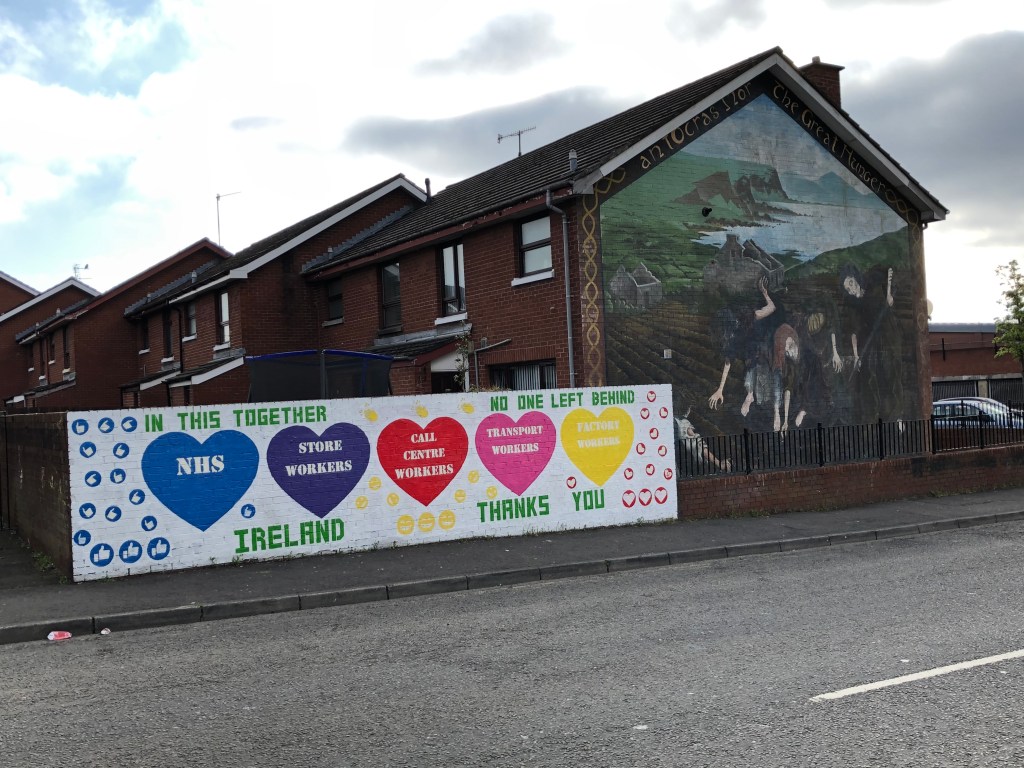
In Northern Ireland the Covid-19 lockdown started in the middle of March 2020 and by the 23rd we were officially social distancing. The fundamental reason for this strategy was to protect the National Health Service, the ‘front line’ for saving lives. At 8.00pm on 26th March people across the UK, most stuck in their homes, stepped out of their doors and leaned out of windows to acknowledge the NHS workers by clapping. This has been repeated every Thursday during the lockdown gaining widespread publicity. In addition, people have been displaying rainbows from windows also in support of the NHS.
For those of us studying anthropology, this immediate representation of our world through rituals, symbols and commemorations is not a surprise. People need to find ways of creating a sense of community, a sense of common activity, and doing so when restricted from the public sphere is an act of resistance as well as an affirmation of cohesion. And this has political ramifications.
We should not assume the meaning that participants are giving to these rituals. People have different reasons for participation. What I think can be suggested is the power of these events in terms of promoting cohesion in a neighborhood and in support for the health service and the enhanced status given to its workers. The power of this apparent national consensus will play out in the politics that follows the lock down. The symbol of the rainbow has taken on new political meaning and this will be important.
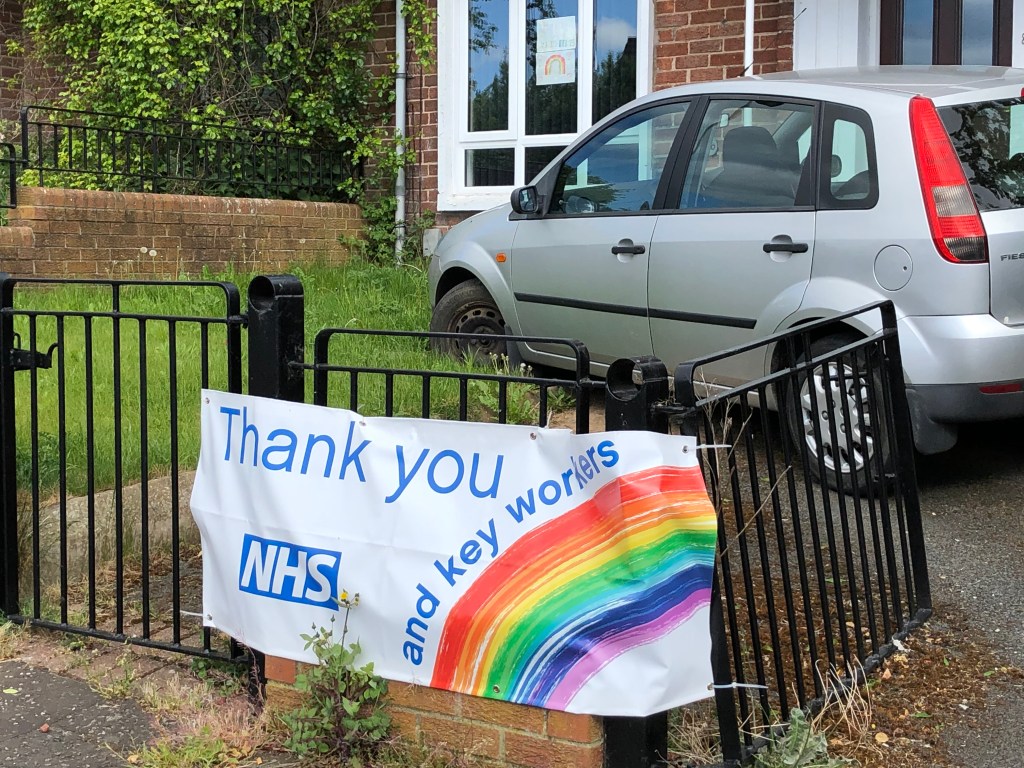
The country was asked to observe a minute’s silence at 11.00am on 28th April for those key workers that have died. This was intended to coincide with International Workers’ Memorial Day on which people killed or injured at work are annually remembered. This commemoration was founded by trade unions in the US whilst in Canada, in 1984, a National Day of Mourning for workers was instituted. Since 2001 the United Nations has recognised it as The World Day for Safety and Health at Work. It is worth noting that whilst the Trade Union Congress cast this act of commemoration within this longer standing event this was lost in media coverage. I am willing to bet that British Prime minister, Boris Johnson, had not recognised this day in the past. But will he in the future?
The use of ‘11.00am’ and the minutes silence is also significant. In UK terms, it mimics the better know and better observed events on Remembrance or Armistice Day when a minute’s silence is also observed at 11.00am to remember those who lost their lives in the service of the military. We are of course well used to the way in which the monarchy and political elite line-up to be at the forefront of this event. But then this day is cast as of national remembrance enhanced by the idea that the conflicts the military serve in, are in all our interest: ‘The Died For Us’. This of course is not uncontested.
We might also note with concern that our society is sometimes appear better at commemorating the sacrifice of those who died in war than looking after those that ‘returned’. This would suggest that those in power find the act of commemoration easier (and cheaper) than the act of investing in the victims and survivors.
It is noticeable that this fits a common political discourse using war as a metaphor in dealing with the pandemic. As Costanza Musu has already cogently argued this war time imagery of the front line, soldiers, sacrifice, and an ‘army of workers’ (The Sun Newspaper) is compelling but also dangerous. It places the struggle within highly nationalistic tones marginalising the global nature of the problem. Already leaders around the world have attempted to depict it as an ‘invasion’ introduced by foreigners. It also casts those in caring and healing professions alongside the military.
In Belfast there have been interesting local symbolic and ritual interpretations of the pandemic. There is evidence of common support for the institution of a public health service across the ethno-political boundaries that structure our society. As such, rainbows, which has become the symbol for supporting front-line workers, have appeared in windows across Belfast. The Thursday night doorstep clap has taken place regardless of the ethnic geography of the city. The NHS has been supported on murals on both sides of the ethno-political divide. Support for the NHS, popular with almost everyone, has been expressed in common public displays. Prior to March 2020 it was difficult to imagine a cause that could garner such universal backing.
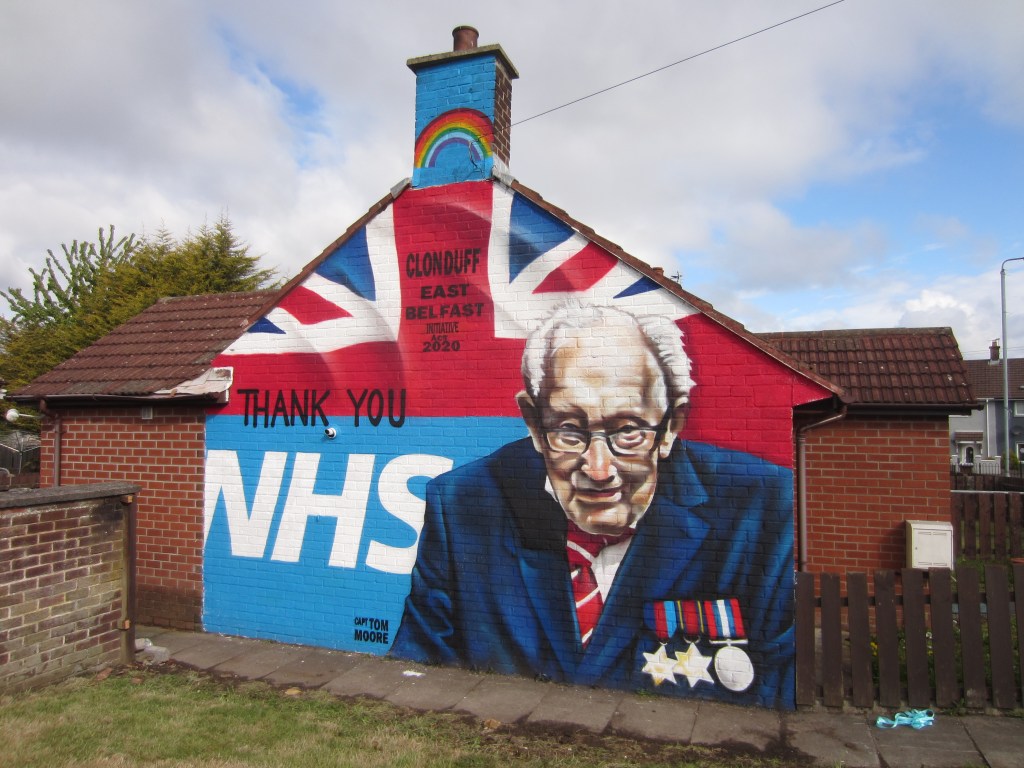
Yet there are differences. The nationalistic approach to ‘combating’ the virus has been reflected in unionist areas of the city with the use of Union Jack flags, some with ‘Support the NHS’ and ‘Thank you to the NHS and all key workers’ written across them. Others have engaged with the militaristic analogy with banners saying ‘No Surrender to Covid-19’. The amazing exploits of 100 year old veteran, Tom Moore, who raised £30 million walking the length of his garden 100 times, was also depicted on a mural in Clonduff, East Belfast, along with his military medals and a rainbow (see above).
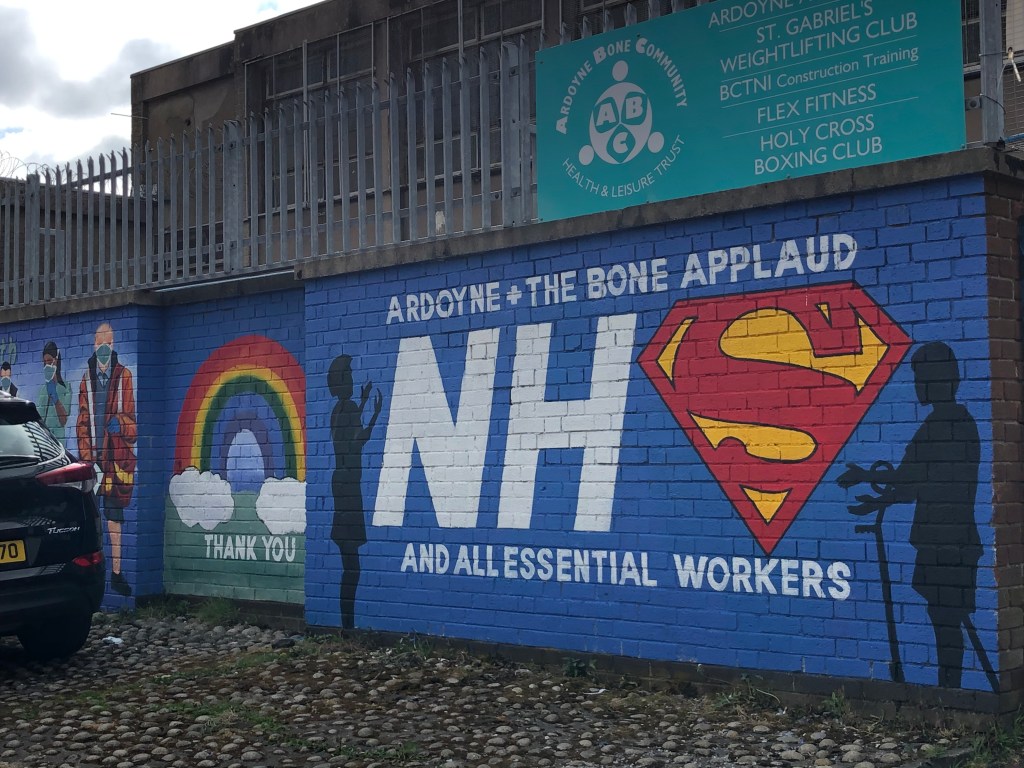
In Irish nationalist areas the narrative has been based on the rainbow and NHS staff as superheroes. Whilst I would not want to exaggerate these differences, as unionist areas have many representations that do not use the symbols of Britishness, there are nevertheless contrasts in commemorative symbols and narratives.
Why is this important? It is important because the financial and political implications of this, when the immediate crisis has past, will be enormous. The new symbolic status of the NHS and frontline workers will have a power that will be competed over by politicians. This will have massive ramifications for what gets publicly funded, and how. There is now competition with the military in the commemorative calendar. Consequently, who we depict as ‘defending’ the country will play out when government departments look at their budgets in years to come.

Staff in Northern Ireland at Queen’s University, the University of Ulster and the Open University, myself included, are on strike again. Staff at Universities all over the UK are on strike again. This is the second time in a year and the third time in three years. It is utterly frustrating that we are back in this position. On the one hand, I know this is a battle that we will struggle to win and that the public tend to see us as a privileged group. On the other hand, working conditions, pay and pensions have been put under such desperate strain by our employers who use the market place to put pressure on its workforce.
To understand why predominantly ‘white-collar workers’ have felt the need to do this we have to understand what has been done to the Higher Education system. Rather than seeing Higher Education as a social good (economic and social) it has been made part of a market place, with student fees (supported by loans), a massive range of metrics upon which staff and institutions are judged, and competitive league tables pitting University against University for students (customers) and research funding. Under this pressure the University have become fiscally conservative (some of them are super rich, others relatively rich, whilst some struggle) and their control of finances concentrates on increasing student numbers, decreasing staff numbers and decreasing the cost of staff.
The direction of the modern UK University is thus set. Student numbers become paramount leading, in some institutions, to the practice of ‘unconditional offers’ for courses desperate to keep numbers high. Universities are investing in campuses around the world to place themselves in the global market. Research has been directed to projects with high social and economic impact. Attractive new-buildings have improved the campuses, relationships with industry and private investors have become a key part of strategies, and Universities invest in courses that will sustain high numbers. Not all of these things are bad, but they provide a problematic context. Spending on staff has not been a priority.
Throughout all of this the pay and conditions have suffered. There has been a significant increase in casualised labour, paid by the hour, to cover a range of teaching. With increased numbers of people studying and obtaining PhD’s (a good thing) there are plenty of highly qualified people forced to take precarious work. They are cheap and easy to let go. They do the work that deserves a secure contract and protection but have only a moderate chance of finding it. Add to this, lots of evidence of gender inequality in terms of pay and promotion. Whilst many Universities and staff are trying hard to make a difference, through the excellent SWAN initiative, there is still a long way to go. And workloads for all staff have been getting more problematic. For many of us a working week of around 50 hours is not unusual, sometimes working 6/7 days a week, and crucially the institutions are very poor at controlling the flow of work.
Then there is the market pressure placed on those in full time contracts. Since 2008 we have been annually offered no increase in pay or an increase below inflation. After 12 years staff are between 15-20% worse off. And within this context they also tried to alter the staff pension scheme (USS) demanding that staff pay more in, substantially reducing their benefits, and offering new staff inferior pension provision. This why our Union, UCU, has designated ‘four fights‘ in the strike.
It is vital remember that within the University there are high paid and low paid staff. It is vital to remember that new academics often spend around 8 years obtaining the qualification necessary for a job and build a mountain of debt in that time. It is vital to remember that some academic related staff work on some considerably lower pay rates. So when a journalists goes for the cheap shot question of asking a more senior academic, like myself, what we get paid (compared to many in society we are, of course, paid well) they are missing the point. We are on strike to make changes to a much wider academic environment in which people are struggling with insecurity, high workloads and decreasing pay.
All of this directly impacts upon students. Staff who lack time are going to produce inferior teaching and care. Student representatives know very well that this fight for a different approach to academic staffing is a fight for students as well, and they are supporting us across the country.
So what do we hear from our Vice-Chancellors and senior managers (who, over the same period, have seen their pay sky-rocket!)? They claim that they are making our institutions ‘sustainable’. They explain that they working within an economic environment that is difficult. And they are right. Running a multi-million £ global institution, that is vital to our economy, is a difficult job. But their strategic decisions to maintain a profitable bottom line involves placing enormous pressure on their staff. How many more years will we be offered a decline in salary? Another 10 years?
It is interesting to note that in the Health Service senior managers become persuaders of Government demanding more funding in the interests of patient and staff. In the public University system, devolved through competing institutions, the management culture conforms to neo-liberal rules and values. There is a lack of radical thinking and an inability to find other ways to finance the greater good provided Higher Education, even though there is a black hole of student debt lying in the Governments finances.
This is why we are on strike. Not because a Professor is badly paid, but because a broken education system is only surviving on dedicated staff working harder for less money. When you see the picket lines outside Universities please look beyond a stereotype of a well-heeled academic and understand what is happening.
This is an example post, originally published as part of Blogging University. Enroll in one of our ten programs, and start your blog right.
You’re going to publish a post today. Don’t worry about how your blog looks. Don’t worry if you haven’t given it a name yet, or you’re feeling overwhelmed. Just click the “New Post” button, and tell us why you’re here.
Why do this?
The post can be short or long, a personal intro to your life or a bloggy mission statement, a manifesto for the future or a simple outline of your the types of things you hope to publish.
To help you get started, here are a few questions:
You’re not locked into any of this; one of the wonderful things about blogs is how they constantly evolve as we learn, grow, and interact with one another — but it’s good to know where and why you started, and articulating your goals may just give you a few other post ideas.
Can’t think how to get started? Just write the first thing that pops into your head. Anne Lamott, author of a book on writing we love, says that you need to give yourself permission to write a “crappy first draft”. Anne makes a great point — just start writing, and worry about editing it later.
When you’re ready to publish, give your post three to five tags that describe your blog’s focus — writing, photography, fiction, parenting, food, cars, movies, sports, whatever. These tags will help others who care about your topics find you in the Reader. Make sure one of the tags is “zerotohero,” so other new bloggers can find you, too.
Have a WordPress.com account? Log in now.

